
Published studies using VidSync
The studies below used VidSync to obtain measurements, calibration data, or time-linked behavioral observations. The list excludes papers that cited VidSync only as an example of a method and redundant versions of the same study. Captions are not full abstracts but descriptions of how each study used VidSync, assembled through an agentic AI pipeline with cross-model verification. If you notice an error or omission, feel free to contact me. This list was reviewed through August 1, 2026.
2025
Dominic Bravenboer. 2025. Fine-Scale Foraging Behaviour and Energy Expenditure of Nominally Herbivorous Coral Reef Fishes; a Comparative Analysis Across a Turbidity Gradient on a Coral Reef in the Solomon Islands. MPhil thesis, Auckland University of Technology. (PDF)
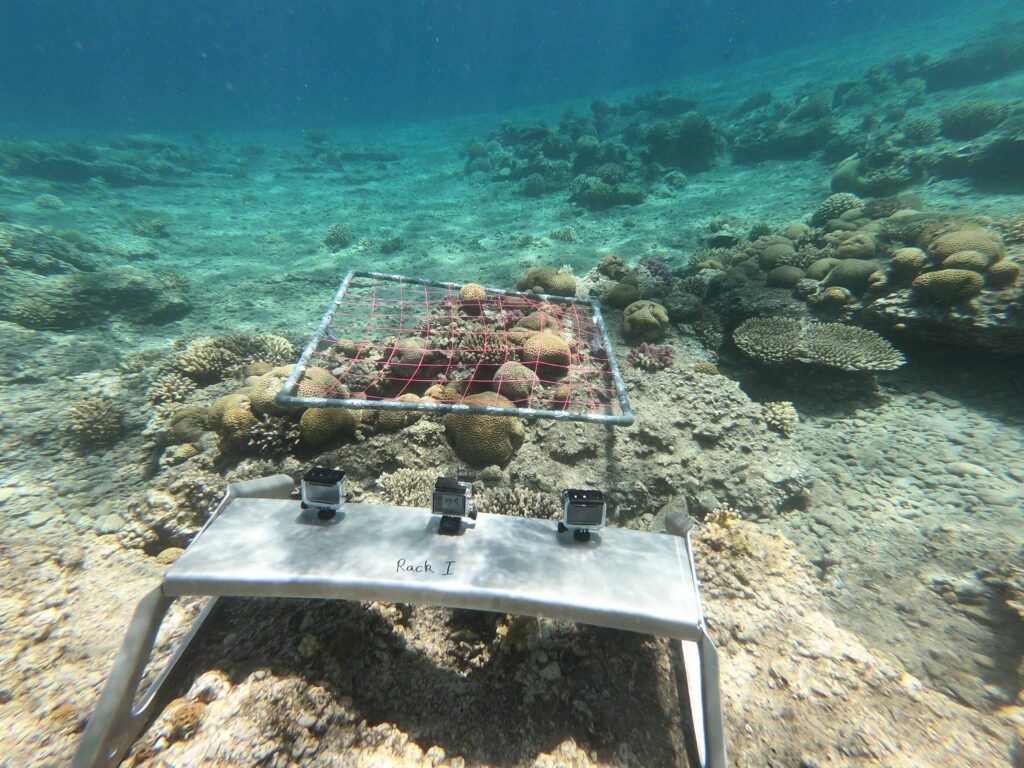
This MPhil thesis examined how turbidity shapes the fine-scale foraging and movement of two nominally herbivorous coral reef fishes, the bristletooth surgeonfish Ctenochaetus striatus and the parrotfish Chlorurus bleekeri, on a naturally turbid Solomon Islands reef. VidSync synchronised the stereo videos, corrected lens distortion, performed the 3-D calibration, and was used to annotate events and measure body length, 3-D swimming tracks, and bite distances; swimming speeds derived from those tracks fed the energy-expenditure estimates.
Maria Salomidi, Alfredo Marchiò, Yiannis Issaris, Vasilis Gerakaris, Thanos Dailianis, Vasilis Gerovasileiou. 2025. Advancing knowledge on red coral Corallium rubrum (Linnaeus, 1758) populations and associated mesophotic communities in the Aegean Sea, Eastern Mediterranean. Mediterranean Marine Science 26(2): 378–392. https://doi.org/10.12681/mms.41403.
The study assessed red coral (Corallium rubrum) populations and associated mesophotic communities at two formerly harvested Aegean sites. VidSync measured colony height, width, and basal diameter from diver-operated stereo-video, supporting population size-structure estimates; colony density came from counts in extracted frames within a stereo-video-estimated 50 x 50 cm field of view.
Ólavur av Fløtum Mittún, Lars Emil Juel Andersen, Morten Bo Søndergaard Svendsen, J. F. Steffensen. 2025. An Inexpensive 3D Camera System Based on a Completely Synchronized Stereo Camera, Open-Source Software, and a Raspberry Pi for Accurate Fish Size, Position, and Swimming Speed. Fishes 10(4): 139. https://doi.org/10.3390/fishes10040139. (PDF)
The study built and validated an inexpensive, completely synchronised Raspberry Pi stereo-camera system for underwater fish biometry. VidSync v1.721 performed the lens-distortion correction and 3-D calibration and made the single-frame triangulated measurements used to validate the system against a marked reference stick and against Atlantic cod lengths; footage was pre-processed separately in Python/OpenCV and FFmpeg, and the synchronisation-error estimates were analytical, not VidSync outputs.
Thibaut Roost, Jade Hargous, Lise Van Espen, Jules Schligler, Shaun S. Killen, Ricardo Beldade, Stephen E. Swearer, Suzanne C. Mills. 2025. Artificial light at night during early development directly affects embryonic but not larval quality in a wild coral reef fish. Conservation Physiology 13(1): coaf041. https://doi.org/10.1093/conphys/coaf041. (PDF)
The study tested effects of artificial light at night on orange-fin anemonefish early development and parental care. VidSync calibrated stereo-video and measured parental total lengths used as covariates.
Jordan E. Elvy, Jane E. Symonds, Zoë Hilton, Seumas P. Walker, Louis A. Tremblay, Paula Casanovas, Neill A. Herbert. 2025. Don’t play with your food: Differences in group feeding behaviours of feed efficient and inefficient Chinook salmon (Oncorhynchus tshawytscha). Applied Animal Behaviour Science 285: 106589. https://doi.org/10.1016/j.applanim.2025.106589.
The study tested whether feed-efficient and feed-inefficient Chinook salmon differ in how they approach, handle, and consume pellets in a group-reared tank. VidSync displayed the three synchronised camera views and stored the on-screen behavioural annotations, which were scored as categories, counts, and time bins (turn angle, distance-travelled level, attempt success, consume vs. reject, handling time, timing within the meal, vertical position, and aggression) rather than as calculated distances.
Christina Papadaki, Dimitris N. Makropoulos, Sergios Lagogiannis, Antonis Kavvadias, Stamatis Zogaris, Elias Dimitriou. 2025. Unlocking flow–habitat relationships in mountain rivers of Epirus, Greece using object detection and hydrodynamic simulation. The Science of The Total Environment 1003: 180703. https://doi.org/10.1016/j.scitotenv.2025.180703.
The study combined underwater stereo-video, machine-learning fish detection (YOLOv8 and Faster R-CNN), and 2-D hydrodynamic modelling to assess West Balkan trout microhabitat suitability in the Voidomatis River, Greece. The scientific video software of Neuswanger et al. (2016) was used for the 3-D videogrammetric observations — fish-to-camera distance, estimated fish size, stationary microhabitat positions, and behaviour category — which were then paired with in-situ ADV/ADCP depth and velocity to build habitat-suitability curves.
2024
Tyson B. Hallbert, Ernest R. Keeley. 2024. Allometric shifts in foraging site selection and area increase energy intake for Yellowstone Cutthroat Trout but are constrained by functional limits to prey capture. Transactions of the American Fisheries Society 153(5): 660–673. https://doi.org/10.1002/tafs.10484. (PDF)
The study examined how body size, habitat, and prey availability influence space use and energy intake by Yellowstone Cutthroat Trout. VidSync calibrated stereo-video and measured fork length, three-dimensional foraging movements and distances, and foraging rates used to estimate capture area and energy intake.
Michaela Holubová, Jiří Peterka, Troy N. Simon, Jason R. Neuswanger, Gary D. Grossman. 2024. Dominance and size affect foraging position choice by Arctic grayling (Thymallus arcticus). Journal of Fish Biology 106(2): 552–563. https://doi.org/10.1111/jfb.15974. (PDF)
The study tested how body size and dominance influence foraging-position choice in Arctic grayling. VidSync measured fork length from underwater video, while focal observations recorded foraging and aggressive behavior.
Julian Lilkendey, Cyril Barrelet, Jingjing Zhang, Michael Meares, Houssam Larbi, Gérard Subsol, Marc Chaumont, Armagan Sabetian. 2024. Herbivorous fish feeding dynamics and energy expenditure on a coral reef: Insights from stereo‐video and AI ‐driven 3D tracking. Ecology and Evolution 14(3): e11070. https://doi.org/10.1002/ece3.11070. (PDF)
The study mapped feeding dynamics and energy expenditure of two surgeonfishes on a Gulf of Aqaba reef by combining stereo-video with AI-driven 3-D tracking. VidSync v1.661 was used for all manual measurements — total length, the substrate grazed at each bite, and the distance between consecutive bites — while the 3-D trajectories and the energy-expenditure estimates came from the separate machine-learning tracking pipeline.
Andria Ansri Utama. 2024. Human and Fish Behaviour Around Fish Aggregating Devices (FADs) in Indonesia. Ph.D. thesis, University of Glasgow. https://doi.org/10.5525/gla.thesis.84638. (PDF)
This dissertation combined acoustic surveys and ROV stereo-video to characterize fish around Indonesian FADs. VidSync processed all underwater videos for species, MaxN, fork length, three-dimensional position, and calibration trials.
Rachael Ryan. 2024. Resilience of an endangered salmon complex: understanding the relationships between habitat heterogeneity, environmental variability, and population diversity. Ph.D. dissertation, University of California, Berkeley. (PDF)
This dissertation examined endangered coho salmon responses to drought across a heterogeneous stream network. VidSync calibrated stereo-video, measured fork lengths, and supported scan-sampling of foraging modes, strikes, conflicts, and abundance.
2023
Adela Belackova, NT Willenbrink, JMS Gonçalves, Bárbara Horta e Costa. 2023. Potential protection effects in a small marine reserve: a demersal community analysis from stereo baited remote underwater video. Marine Ecology Progress Series 708: 79–100. https://doi.org/10.3354/meps14259.
The study assessed potential protection effects in a small marine reserve using stereo baited remote underwater video. VidSync processed the stereo-video to obtain fish identifications, abundance indices, and body-size measurements.
Jean López-Macías, Estefanía Bravo-Ormaza, Nicole Chinacalle-Martínez, Cristina Miranda, Juan Carlos Murillo-Posada, Felipe García Vallejo, César Peñaherrera-Palma. 2023. Comparison of Two Stereo-Video Software for the Assessment of Marine Resources. Thalassas: An International Journal of Marine Sciences 39(1): 395–404. https://doi.org/10.1007/s41208-022-00507-4.
The study compared VidSync and EventMeasure for measuring marine resources from stereo-video. Both programs measured known-length targets under controlled conditions and pelagic fish in the open ocean to assess accuracy and precision.
Robert Lewis, Steve Dawson, Will Rayment. 2023. Size structure of broadnose sevengill sharks (Notorynchus cepedianus) in Sawdust Bay, Rakiura/Stewart Island, estimated using underwater stereo-photogrammetry. New Zealand Journal of Marine and Freshwater Research 57(1): 104–118. https://doi.org/10.1080/00288330.2021.1968010.
The study quantified the size and sex structure of broadnose sevengill sharks in Sawdust Bay. VidSync synchronized and calibrated the stereo-video system and measured repeated pre-dorsal lengths of free-swimming sharks; total length was then estimated from those measurements using a published biometric equation.
Kessin Ângelo Guimarães Cabral. 2023. Aplicabilidade da stereo-BRUV para estimar a abundância e a estrutura de tamanho corporal do Oligosarcus paranensis (Menezes & Gery, 1983) em um riacho de cabeceira. Master’s dissertation, Universidade Federal de São João del-Rei. 54 pp. (PDF)
This master’s dissertation evaluated stereo-BRUV estimates of abundance and body-size structure for Oligosarcus paranensis in a Brazilian headwater stream, including accuracy trials with model fish. VidSync corrected and calibrated the stereo-video and measured standard lengths of field fish and repeated model-fish targets used to quantify measurement error.
2022
Darien R. Satterfield, Thomas Claverie, Peter C. Wainwright. 2022. Body shape and mode of propulsion do not constrain routine swimming in coral reef fishes. Functional Ecology 37(2): 343–357. https://doi.org/10.1111/1365-2435.14227. (PDF)
The study tested whether body shape and propulsion mode constrain routine swimming in coral reef fishes. VidSync was used to measure body size and manually digitize three-dimensional swimming behavior from stereo-video.
Nina M. D. Schiettekatte, Francesca Conte, Beverly J. French, Simon J. Brandl, Christopher J. Fulton, Alexandre Mercière, Tommy Norin, Sébastien Villéger, Valériano Parravicini. 2022. Combining stereo‐video monitoring and physiological trials to estimate reef fish metabolic demands in the wild. Ecology and Evolution 12(7): e9084. https://doi.org/10.1002/ece3.9084. (PDF)
The study estimated the metabolic demands of wild reef fishes by pairing respirometry trials with field swimming speeds from seafloor stereo-video. VidSync synchronised and calibrated the cameras and measured fish body length and frame-to-frame 3-D distances; swimming speed was calculated from those distances, while metabolic rates came from the separate respirometry trials.
Ridge Sliger, Gary D. Grossman. 2022. Foraging Dynamics of a Domesticated Strain of Brook Trout. North American Journal of Fisheries Management 42(5): 1340–1348. https://doi.org/10.1002/nafm.10825.
The study characterized foraging dynamics in domesticated Brook Trout for comparison with wild populations. VidSync provided three-dimensional measurements of prey velocity and fish reactive distance.
Nicolas Loiseau, Sébastien Villéger, Charles Le Bozec, Marie Gimenez, Seiji KAWAHARA, Thomas Claverie. 2022. Mesophotic reefs are not refugia for neither taxonomic nor functional diversity of reef fishes. Coral Reefs 42(1): 63–75. https://doi.org/10.1007/s00338-022-02311-1. (PDF)
The study compared fish taxonomic and functional diversity from shallow to mesophotic reefs around Mayotte. VidSync performed stereo-video calibration and three-dimensional fish-size measurements used to estimate biomass; functional traits were assigned separately from published trait data.
Gabriel J. Rossi, Mary E. Power, Stephanie M. Carlson, Theodore E. Grantham. 2022. Seasonal growth potential of Oncorhynchus mykiss in streams with contrasting prey phenology and streamflow. Ecosphere 13(9). https://doi.org/10.1002/ecs2.4211.
The study compared seasonal habitat, prey availability, and modeled growth potential for juvenile Oncorhynchus mykiss in perennial Elder Creek and intermittent Porter Creek. VidSync was used to compute fish foraging movement as distance traveled during each 3-second interval; the authors also discuss using such movement data to improve swimming-cost and occupied-foraging-volume estimates.
Jason R. Neuswanger, Amanda E. Rosenberger, Mark S. Wipfli, Nicholas F. Hughes. 2022. Territories within groups: the dynamic competition of drift-feeding juvenile Chinook salmon in 3-dimensional space. Canadian Journal of Fisheries and Aquatic Sciences 80(2): 346–359. https://doi.org/10.1139/cjfas-2022-0112. (PDF)
The study examined dynamic territoriality within groups of drift-feeding juvenile Chinook salmon. VidSync recorded thousands of three-dimensional fish positions, lengths, feeding locations, and aggressive conflicts.
2021
Ridge Sliger, Gary D. Grossman. 2021. Foraging dynamics of Southern Brook Charr (Salvelinus fontinalis). Environmental Biology of Fishes 104(7): 825–835. https://doi.org/10.1007/s10641-021-01117-4. (PDF)
The study tested how water velocity, fish size, captivity, dominance, and size rank affect foraging by Southern Brook Charr. VidSync was used with paired GoPro recordings to measure prey velocity and fish reactive distance in three dimensions; prey-capture success was observed separately, holding velocity was measured with a flow meter, and fish length was measured directly.
Gabriel J. Rossi, Mary E. Power, Shelley Pneh, Jason R. Neuswanger, Timothy J. Caldwell. 2021. Foraging modes and movements of Oncorhynchus mykiss as flow and invertebrate drift recede in a California stream. Canadian Journal of Fisheries and Aquatic Sciences 78(8): 1045–1056. https://doi.org/10.1139/cjfas-2020-0398. (PDF)
The study linked the seasonal recession of flow and invertebrate drift to changes in foraging mode and movement by Oncorhynchus mykiss in a California stream. VidSync was used to triangulate timestamped 3-D nose-point positions of individual fish at 3-second intervals, each tagged with a qualitative behaviour, from which foraging movement rates were computed; the authors note that body size was not measured in VidSync in this study.
Madeline Steinberg, Jean‐Baptiste Juhel, Virginie Marques, Clara Péron, Régis Hocdé, Andrea Polanco F., Loïc Pellissier, Sébastien Villéger, David Mouillot, Tom B. Letessier. 2021. Similar trait structure and vulnerability in pelagic fish faunas on two remote island systems. Marine Biology 169(1). https://doi.org/10.1007/s00227-021-03998-6.
The study compared the trait structure and fishing vulnerability of pelagic fish assemblages around two remote island systems using drifting mid-water BRUVS. VidSync was used to review the BRUVS footage, identify species, and record MaxN relative abundance; the paper states that no stereo length measurements were made, so biomass and trait values were taken from FishBase and the literature.
Mathilde Maslin, Silvain Louis, Karen Godary-Dejean, L. Lapierre, Sébastien Villéger, Thomas Claverie. 2021. Underwater robots provide similar fish biodiversity assessments as divers on coral reefs. Remote Sensing in Ecology and Conservation 7(4): 567–578. https://doi.org/10.1002/rse2.209. (PDF)
The study compared underwater robots with divers for surveying coral-reef fish biodiversity. VidSync performed stereo calibration and three-dimensional fish measurements used to estimate size, distance, and biomass.
Rory Mott, Amanda E. Rosenberger, Doug Novinger. 2021. Use of non-lethal endpoints to establish water quality requirements and optima of the endangered Topeka shiner (Notropis topeka). Environmental Biology of Fishes 104(10): 1215–1233. https://doi.org/10.1007/s10641-021-01148-x. (PDF)
The study evaluated non-lethal behavioral responses of Topeka shiner during gradual hypoxia. VidSync triangulated three-dimensional fish positions at selected oxygen concentrations to quantify movement toward the surface; aquatic surface respiration and other behavioral endpoints were scored separately from the video record.
2020
Ashlie J. McIvor. 2020. Assessing sharks and rays in shallow coastal habitats using baited underwater video and aerial surveys in the Red Sea. Master’s thesis, King Abdullah University of Science and Technology. https://doi.org/10.25781/kaust-287i6. (PDF)
This master’s thesis compared baited underwater-video and aerial surveys of sharks and rays in shallow Saudi Red Sea habitats. VidSync was used to annotate every BRUV deployment, recording species, arrival events, relative-abundance metrics, visibility, and field-of-view conditions.
Samuel T. Swanson, Desirèe Tullos, R. Andrew Goodwin. 2020. Experiments on the hydraulics and swimming responses of juvenile Chinook Salmon encountering a floating guidance structure. River Research and Applications 36(8): 1633–1645. https://doi.org/10.1002/rra.3693. (PDF)
The study examined hydraulics and juvenile Chinook salmon responses to a floating guidance structure. VidSync was used to digitize complete three-dimensional swim paths during each fish’s first encounter.
Gabriel J. Rossi. 2020. Food, Phenology, and Flow—How Prey Phenology and Streamflow Dynamics Affect the Behavior, Ecology, and Recovery of Pacific Salmon. Ph.D. dissertation, University of California, Berkeley. (PDF)
This dissertation examined how prey phenology and streamflow shape juvenile Oncorhynchus mykiss foraging, movement, habitat use, and growth potential across three field studies. VidSync produced time-stamped 3-D fish positions, behavior and aggression annotations, and length measurements; the dissertation contains broader VidSync documentation and analyses than the corresponding journal articles.
Dorothée Kopp, Yann Coupeau, Benoît Vincent, Fabien Morandeau, Sonia Méhault, Julien Simon. 2020. The low impact of fish traps on the seabed makes it an eco-friendly fishing technique. PLoS ONE 15(8): e0237819. https://doi.org/10.1371/journal.pone.0237819. (PDF)
The study quantified how baited fish traps move on and contact the seabed, as an indicator of fishing-gear impact. VidSync synchronised the stereo-video, applied the chessboard distortion correction and 3-D calibration-frame calibration, and measured the three-dimensional position of a white reference buoy on the trap every 10 minutes, from which trap displacement and seabed interaction were derived.
2019
Jeffrey L Cullen, Gary D. Grossman. 2019. Aggressive interactions affect foraging and use of space in a drift foraging salmonid, Salvelinus malma (Salmoniformes: Salmonidae). Zoological Journal of the Linnean Society 187(3): 774–781. https://doi.org/10.1093/zoolinnean/zlz050. (PDF)
The study tested how aggressive interactions affect foraging and spatial behavior in drift-feeding Dolly Varden. Using paired underwater cameras, VidSync supplied precise time-linked 3-D distance measurements for movement and holding-velocity analyses and supported synchronized scoring of bout outcomes, stream positions, durations, and foraging events.
Adriana Milena Cruz Jiménez. 2019. Ensambles de peces en los bosques de kelp de Macrocystis pyrifera en el Canal Beagle, Tierra del Fuego: estructura comunitaria y variación espacio-temporal. Doctoral dissertation, Universidad Nacional de La Plata. https://doi.org/10.35537/10915/79453. (PDF)
This dissertation studied fish assemblages in Macrocystis kelp forests of the Beagle Channel. VidSync analyzed baited stereo-video for abundance, diversity, body size, and use of bottom versus mid-upper kelp strata.
Bryan B. Bozeman, Gary D. Grossman. 2019. Foraging behaviour and optimal microhabitat selection in Yukon River Basin nonanadromous Dolly Varden Charr (Salvelinus malma). Ecology Of Freshwater Fish 28(4): 586–601. https://doi.org/10.1111/eff.12477. (PDF)
The study examined how water velocity affects Dolly Varden foraging and whether a net-energy model predicts selected microhabitats. VidSync measured laboratory prey-capture velocity and three-dimensional reactive distance and was also used with stereo-video tracers to estimate field holding and capture velocities; laboratory treatment and holding velocities were measured separately with an electronic flow meter.
Aurélien Vivancos, Gerry Closs. 2019. Using fine-scale spatial analysis to study behavioural strategies prevalence in wild groups of drift-feeding fish. Canadian Journal of Fisheries and Aquatic Sciences 76(10): 1854–1861. https://doi.org/10.1139/cjfas-2018-0221.
The study quantified alternative behavioral strategies within wild groups of drift-feeding fish. VidSync provided fine-scale 3-D locations used for individual space-use and strategy analyses.
2018
Bryan B. Bozeman, Gary D. Grossman. 2018. Mechanics of foraging success and optimal microhabitat selection in Alaskan Arctic grayling (Thymallus arcticus). Canadian Journal of Fisheries and Aquatic Sciences 76(5): 815–830. https://doi.org/10.1139/cjfas-2018-0115. (PDF)
The study tested how water velocity and social dominance shape prey capture and microhabitat selection by Alaskan Arctic grayling, and evaluated a net-energy-intake model. In the flume experiments VidSync measured reactive distances and computed prey capture velocity from the elapsed time and distance between marked prey positions in the synchronised stereo videos; in the field comparison VidSync supplied holding and capture velocities from stereo video. Flume treatment and holding velocities were measured with an electronic velocity meter.
Erik Donofrio, Troy N. Simon, Jason R. Neuswanger, Gary D. Grossman. 2018. Velocity and dominance affect prey capture and microhabitat selection in juvenile Chinook (Oncorhynchus tshawytscha). Environmental Biology of Fishes 101(4): 609–622. https://doi.org/10.1007/s10641-018-0723-5.
The study tested how current velocity and social dominance affect prey capture and microhabitat selection by juvenile Chinook salmon. VidSync measured three-dimensional reactive distance in the later laboratory experiments, stored position and prey-capture records for dominance trials, and calculated field focal-point velocities from stereo-video tracers; laboratory holding velocities and fish length were measured separately.
Esther Savina, Ludvig Ahm Krag, Niels Madsen. 2018. Developing and testing a computer vision method to quantify 3D movements of bottom-set gillnets on the seabed. ICES Journal of Marine Science 75(2): 814–824. https://doi.org/10.1093/icesjms/fsx194.
The study tested a stereo-video method for quantifying how bottom-set gillnets move on the seabed. VidSync calibrated the cameras and reconstructed three-dimensional trajectories of marked leadline points, enabling comparisons of displacement, swept area, and measurement error for light and heavy nets.
2016
Aurélien Vivancos, Gerry Closs, Cédric Tentelier. 2016. Are 2D space-use analyses adapted to animals living in 3D environments? A case study on a fish shoal. Behavioral Ecology: arw175. https://doi.org/10.1093/beheco/arw175.
The study tested whether conventional 2-D space-use analyses distort patterns for fish moving in three dimensions. VidSync provided the fine-scale 3-D fish positions used to compare 2-D and 3-D estimates.
Desirée D. Tullos, Cara Walter, Jason B. Dunham. 2016. Does resolution of flow field observation influence apparent habitat use and energy expenditure in juvenile coho salmon? Water Resources Research 52(8): 5938–5950. https://doi.org/10.1002/2015wr018501. (PDF)
The study tested how the spatial resolution of flow measurements changes conclusions about juvenile coho salmon habitat use and swimming-energy costs in an experimental stream. VidSync supplied three-dimensional fish locations at 20-second intervals; tailbeat frequencies were counted separately from a subset of the videos and combined with hydraulic measurements in the energy analysis.
2015
Desirée Tullos, Cara Walter. 2015. Fish use of turbulence around wood in winter: physical experiments on hydraulic variability and habitat selection by juvenile coho salmon, Oncorhynchus kisutch. Environmental Biology of Fishes 98(5): 1339–1353. https://doi.org/10.1007/s10641-014-0362-4. (PDF)
The study tested which hydraulic features juvenile coho salmon select around a model log jam in winter. VidSync-derived fish locations were related to depth, distance from wood, velocity, and turbulence.
Erik R. Schoen. 2015. Linking the individual-level foraging interactions of piscivores to food-web dynamics in pelagic systems. Ph.D. dissertation, University of Washington. (PDF)
This dissertation examined how turbidity and prey shoaling affect Chinook salmon attacks on Pacific herring in a large circular arena. VidSync synchronised and displayed the four overhead camera views and was used to log the predation-sequence behaviours and take the 2-D reaction-distance measurements.
Aurélien Vivancos, Gerard P. Closs. 2015. Quantification and comparison of individual space-use strategies in foraging drift-feeding fish using fine-scale, multidimensional movement analysis. Canadian Journal of Fisheries and Aquatic Sciences 72(11): 1760–1768. https://doi.org/10.1139/cjfas-2015-0006.
The study compared fine-scale space-use strategies of juvenile roundhead galaxiids and brown trout in natural drift-feeding groups. VidSync manually reconstructed three-dimensional fish positions and feeding events from stereo-video and measured fish length, providing the movement and prey-capture-distance data used in the space-use analyses.
2014
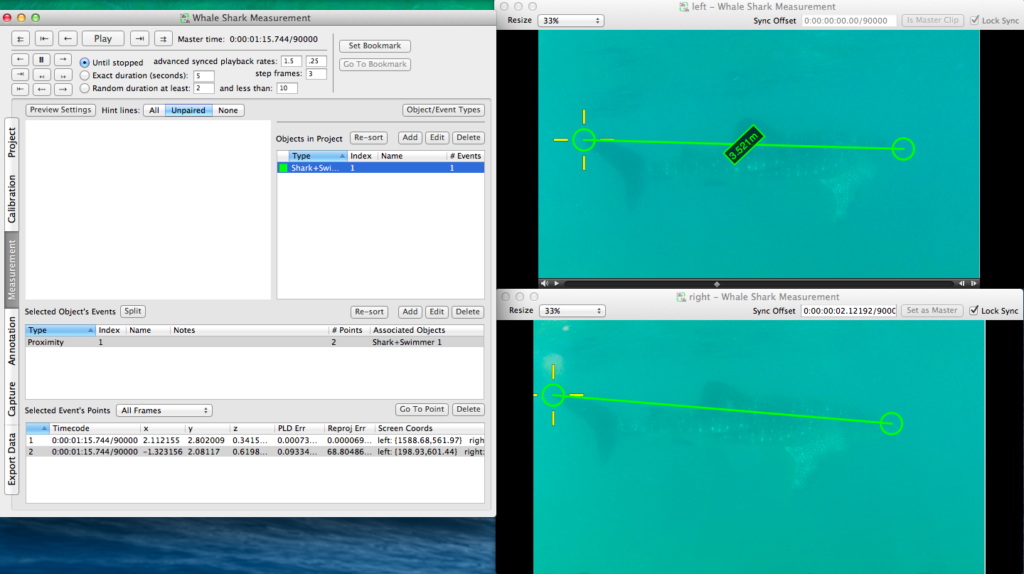
Darren A. Whitehead. 2014. Establishing a Quantifiable Model of Whale Shark Avoidance Behaviours to Anthropogenic Impacts in Tourism Encounters to Inform Management Actions. Master’s thesis, University of Hertfordshire. https://doi.org/10.18745/th.14655. (PDF)
This MSc thesis quantified whale shark avoidance responses during tourism encounters at three sites. VidSync 1.2 was used to synchronise the stereo videos, correct lens distortion, and calibrate the stereo-photogrammetric system, and to measure the proximity between swimmers and sharks that underpinned the avoidance-behaviour analysis.
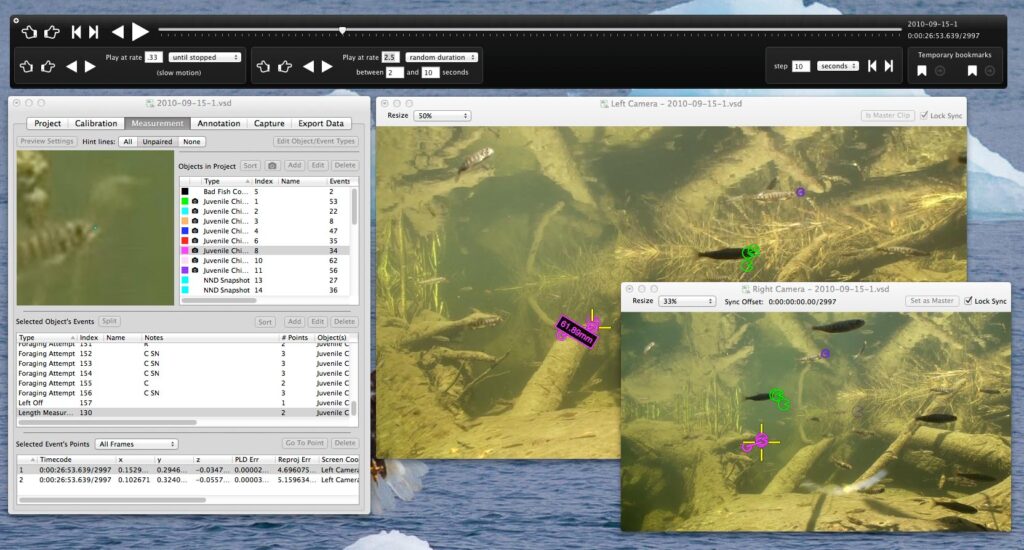
Jason R. Neuswanger, Mark S. Wipfli, Amanda E. Rosenberger, Nicholas F. Hughes. 2014. Mechanisms of drift-feeding behavior in juvenile Chinook salmon and the role of inedible debris in a clear water Alaskan stream. Environmental Biology of Fishes 97(5): 489–503. https://doi.org/10.1007/s10641-014-0227-x.
The study examined how juvenile Chinook salmon react to prey and inedible drifting debris in a clear Alaskan river. VidSync analyzed the stereo-video and recorded fork length, three-dimensional positions and timecodes through each foraging attempt, attempt outcomes, debris trajectories, and nearest-neighbor positions, supporting the study’s pursuit, detection, handling, and rate calculations.
2012
Megan T. Perry. 2012. Growth of juvenile Chinook salmon (Oncorhynchus tshawytscha) as an indicator of density-dependence in the Chena River. Master’s thesis, University of Alaska Fairbanks. (PDF)
This thesis tested food limitation and density dependence in juvenile Chinook salmon. VidSync supplied remote length measurements used to estimate growth through time.